Unless you are a politics or economics wonk you probably haven’t heard of Paul Johnson, but his influence is everywhere in modern British economics. Johnson has been the head of the influential Institute for Fiscal Studies (IFS) since 2011, and it is to him that both politicians and commentators turn following a budget or major financial statement to understand the story behind the political spin. It is Johnson’s IFS who warned of the “Conspiracy of silence” of the major parties at the General Election who, he claimed, were not being honest about the scale of the problem in the public finances for whoever formed the next government. Unlike other think tanks who may get their funding from very opaque methods, the IFS is considered trustworthy and indeed very influential. So, what can Johnson’s book Follow the Money tell us about the cost of the UK in the 21st Century?
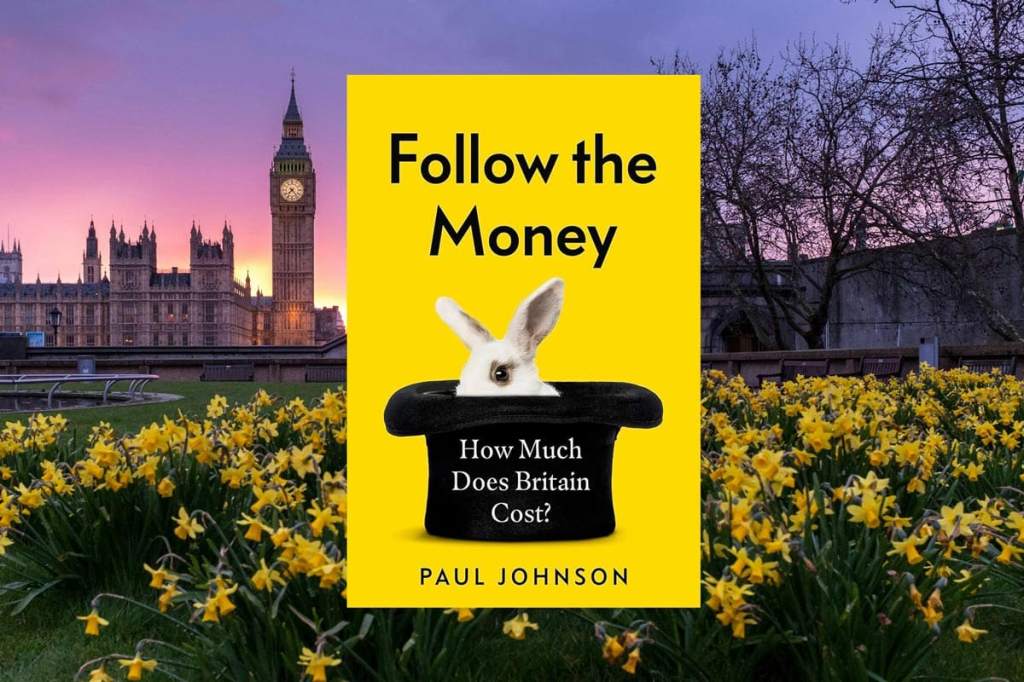
Divided into 10 chapters, Follow the Money goes through the journey of our taxpayer’s money. It starts by discussing how we are taxed, before going on to explain how that money is spent by the Government. Simple enough? Yes, but on the way, Johnson reveals some of the ludicrous ways in which the system is set up. Starting with how we are taxed, in the first two chapters Johnson starts to lift up the floorboards of how fiendishly complicated our tax system is. His analysis starts with the ‘big 3’ earners for the Treasury: Income Tax, National Insurance and VAT which together these account for around 2/3 of all tax takings. He then goes on to smaller earners such as fuel duty, inheritance tax and stamp duty. Johnson reveals how financial pressures and political manoeuvring can make even these difficult to get right. Taking National Insurance, for example, Johnson explains that while originally this was intended to pay for socialised health care, this link has essentially broken, and this is now just a general taxation. However, as it is only paid by employees and employers, for those who are self-employed (for example partners in a law firm) this can be avoided. Similarly, Johnson explains some farcical exemptions in VAT – for example the famous ruling that despite being sold in the biscuit isle and being eaten like a biscuit, a Jaffa cake is a cake. While to many this distinction may seem irrelevant, this meant that McVitie’s could avoid paying VAT, as chocolate covered cakes are exempt, while chocolate covered biscuits are not. What these chapters cleverly show is that while you’d think designing tax policy should be straight forward (decide the rules, implement and enforce them), in reality they are fiendishly complex. Lawyers will argue on the interpretation of the rules (like in the case of Jaffa cakes) and companies will change their practices to avoid paying them (like food delivery companies who attempted to classify their riders as self employed rather than workers to avoid employment related liabilities).
Having given a whistlestop tour of how tax is taken, Johnson then explains where it goes. Each of the following 7 chapters focuses on a different area: welfare, pensions, health, social care, schools, further education and local/devolved government. Each chapter begins with a simple box revealing the price tag (usually somewhere in the billions). The numbers evoked in each chapter are huge, and the statistics sometimes overwhelming. It is to Johnson’s credit that he has a wealth of expertise to draw on to explain how this spending works and how it impacts those that live in the UK. But after a while the sheer number of colliding stats can begin to bamboozle. While this would undoubtedly make the book longer, the addition of charts or graphs to illustrate some of the basics may have been helpful; for example, to demonstrate how spending has changed over time, or how a policy or spending decision has impacted the population. Instead, it can be easy to lose yourself in the numbers and not appreciate the pace or scale of change.
Having given a basic explainer of the history of spending in each field, Johnson then gives his view of what could or should be changed to improve things. While other books written by politicians diagnose the problem and then propose that radical solutions or a complete overhaul is the only thing that can solve things, Johnson often cautions against this approach. Johnson often acknowledges that current policy is far from perfect but explains that lurching from one reform to another without allowing time for any one policy to properly embed can be even more damaging. He gives examples of NHS reforms, whereby subsequent Governments have legislated and demanded top-down reorganisation – the effect of this is that the dust has barely settled on one restructure before another begins. As Johnson explains this can be damaging, and in fields as vital as healthcare there is potentially both a financial and human cost to be paid. Instead, Johnson often suggests a small incremental approach to change or simplification.
It is the tragedy of any non-fiction book that they are out of date almost as soon as they are published, but it is interesting to see the areas that Paul Johnson highlights in the final chapter of Follow the Money that any future government must focus on. These are spelt out very briefly, and each could have been the focus of a chapter in their own right: military spending, climate change, our ageing population, and the issue of growth. These are now some of the most important issues that the new government is facing. With the war in Ukraine and conflict in the Middle East, military spending is featuring as a larger concern for Western governments than at any time since the end of the cold war. The new Labour government are at least attempting to tackle climate change by fundamentally changing how we generate our electricity. And Starmer and Reeves (much like Liz Truss) believe that growth is the solution going forward to help ensure prosperity without increasing borrowing or raising taxes. Follow the Money helps to explain why the issues facing any Government are so pressing and so complex. Paul Johnson clearly has his pulse on the issues facing the economy and public spending, and in Follow the Money he starts to outline this with impressive clarity and purpose.
‘Follow the Money: How Much Does Britain Cost?’ is written by Paul Johnson and published by little,brown books


 Politics with Alex
Leave a comment