Hope is a powerful thing, particularly in politics. In 2008, a senator from Illinois by the name of Barack Obama used the power of hope, through the simple phrase “yes we can” and the now iconic poster with his face and the word “hope” to help him get elected as the first African-American the President of the United States of America. In 2016, the side advocating for a leave vote in the Brexit referendum did so partly on the hope that things could and would get better once “unshackled” from the constraints of our European neighbours and contrasted their cause against the “project fear” message of the remain campaign. These sunlit uplands were promised, and yet have spectacularly failed to materialise and have instead made trade more difficult resulting in an economy being 2-3% smaller than if we hadn’t left, among many other unresolved issues.
There is a real danger in promising hope, of promising change, of promising things will get better if they then don’t. In the USA this arguably helped to pave the way for the disaster that was President Donald Trump. In the UK, this has also led to the rise of populism, and the scapegoating of immigrants by parties such as Reform UK when things don’t improve. It’s very easy to blame those people arriving on your shores for all the ills in the world; why you can’t get a doctors appointment, why the trains don’t run on time. Indeed, Nigel Farage has made a career out of doing so, even blaming potholes on immigrants.
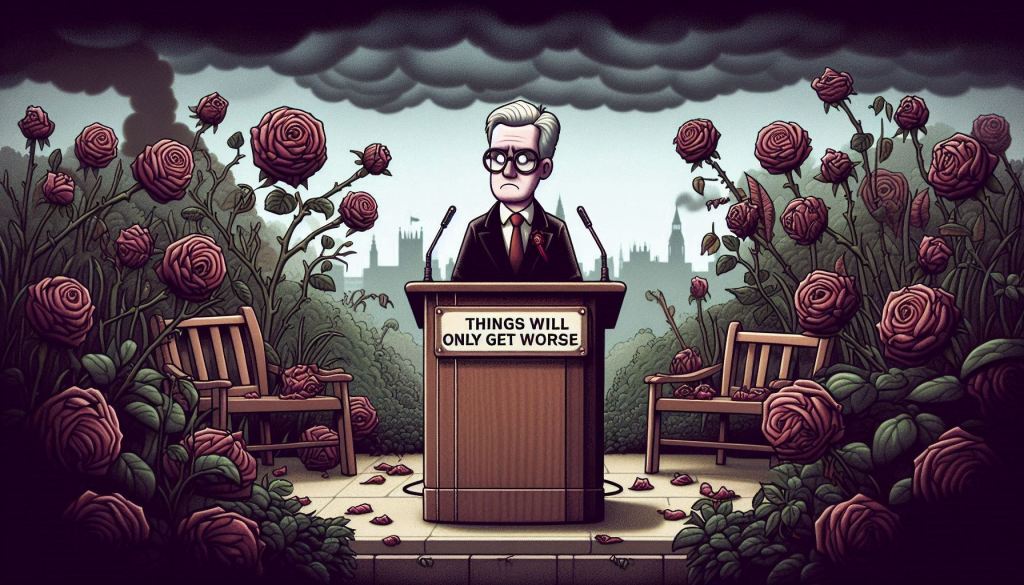
These are the “Snake Oil Salesmen” that Keir Starmer has warned against, who are peddling easy solutions to complex issues. His solution lies in honesty, to the extent that less than two months after winning a landslide election victory, he addressed the nation at a set piece event in the Rose Garden at Downing Street to tell us that things will get worse before they get better. Starmer’s message was evidently a way of preparing for difficult decisions in the budget, and that things would take time to show any signs of improvement. Indeed, if we consider the metaphor often employed by Cameron and Osborne of “fixing the roof while the sun is shining”, and compare it to the three word slogan on Starmer’s lectern of “fixing the foundations”, it seems that the Osborne et al did not manage to fully repair the roof, the rain has got in and caused further damage to the metaphorical timbers and brickwork of the UK. As anyone who has dealt with a similar issue in their house knows, it’s much quicker to fix such issues properly and early, than to let the rot set in.
We have been warned of “hard choices ahead” in the upcoming budget, and we have been told about the “unexpected black hole” that Labour inherited from the Conservatives. But what choices might Reeves end up making? By ruling out increases in the three main sources of tax revenue (income tax, national insurance, VAT) during the election campaign, and also ruling out tax rises on “working people” (whatever that means), the Labour Government have two choices:
- Increase other taxes such as fuel duty or inheritance tax which will be unpopular and won’t bring in as much revenue as others.
- Break their election promise, arguing that it’s due to the “situation they have found themselves in” and risk rebellion from their own backbenchers as well as attacks from all sides.
It seems to be unrealistic that Labour would go down the second path, as this would be politically very damaging. Yet the first path also has risks; what are taxes on “working people”? Is fuel duty, paid by everyone who fills up a vehicle with fuel, a tax on working people? Some people who work don’t own a car, and many who do own a car don’t or no longer work. Is an increase in capital gains tax, that is tax paid on the increased value of an asset, workable, or will it simply lead to tax avoidance on an industrial scale? Is a wealth tax feasible in any way, or will those who would be forced to pay it simply use clever accounting to move their assets to a different country?
There are no easy answers; that’s part of the point here. If there was a simple solution, a painless one, it would have been done already. In a statement to Parliament before recess, Rachel Reeves has already made one difficult decision; removing the winter fuel allowance from around 10 million of those not in receipt of pension credit. On the face of it this seems sensible; there are plenty of wealthy older people (the King for example) who receive this payment, but clearly have no need of it. Yet at the same time, there are many other pensioners who are close to the threshold and who need the help, particularly when bills are set up to go up by an average of 10% in October.
In his Rose Garden speech, Starmer is clearly preparing the ground for further difficult decisions. But there is only a finite amount of time people will accept this, before they want to hear (and more importantly see) that things are on an upwards trajectory again, and that things are going to improve. The last time Labour won a landslide victory and came to power was in 1997 under Blair, with the memorable campaign anthem of D:ream’s “Things can only get better”. This song has since reared its head again by being blasted at Rishi Sunak during his rain-soaked election announcement, which seemed to foretell his political demise. Now Labour are in power again, but this time they are keen to stress the opposite – that things (for now at least) will only get worse.

 Politics with Alex
Leave a comment