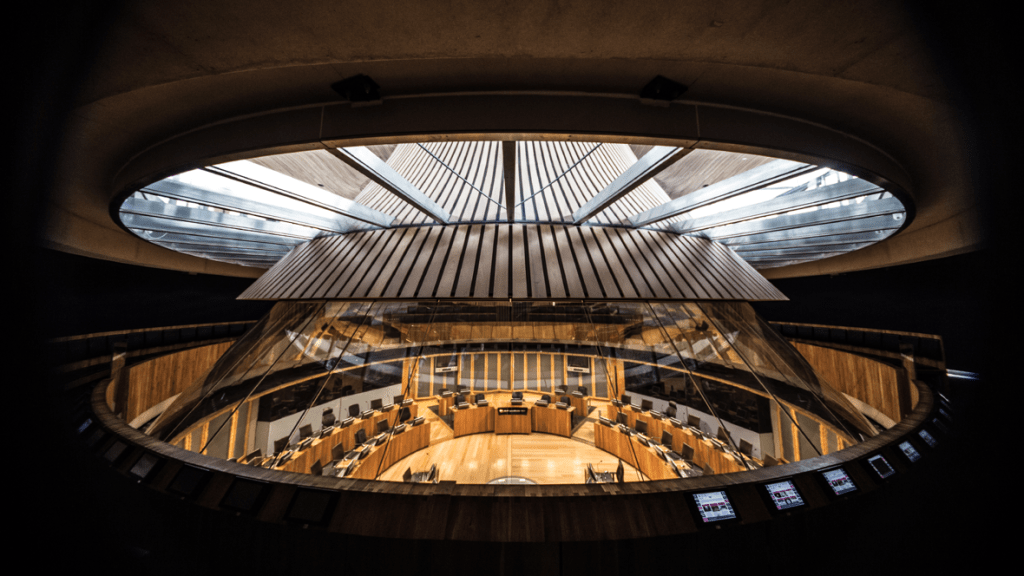
This is the first in a series of articles exploring changes to the Senedd in the upcoming 2026 Senedd Elections
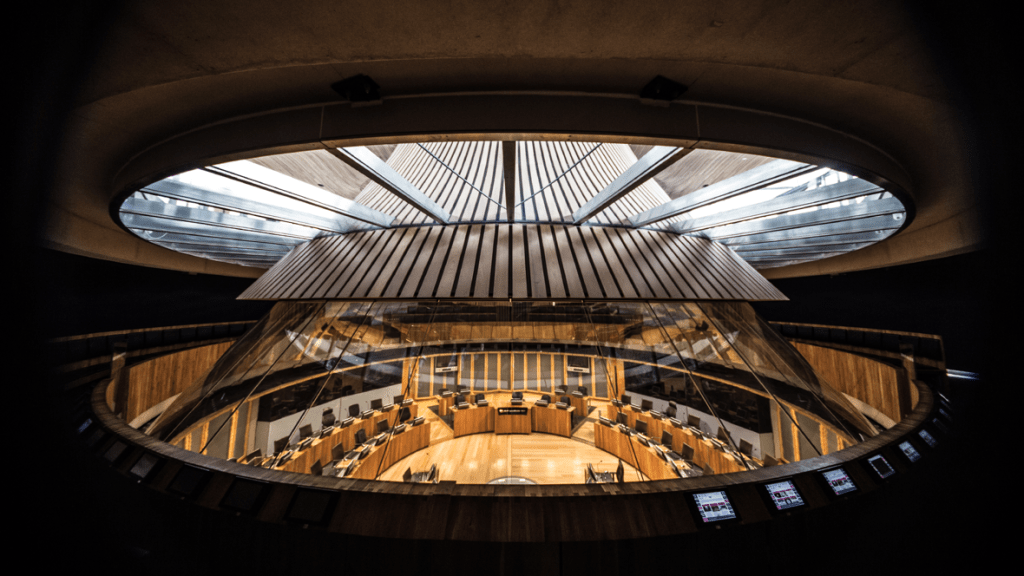
According to some research, politicians in the UK have never been less popular. IPSOS reporting which asks people annually how much they trust different professions has suggested that only 9% of people trust “politicians generally”, only slightly below “Government Ministers”(10%). Even advertising executives (16%) and estate agents (28%), known for sometimes being economic with the truth, fare better. So, never one to shy away from doing something apparently unpopular with the public (20mph speed limits anyone?), the Welsh Labour Government have decided that now is the time to expand the size of the Senedd from 60 to 96 members and give people more politicians. But much like the unpopular speed limit reduction in Wales may have helped to reduce road deaths by up to 100 a year, could an increase in the number of elected politicians in Cardiff Bay actually provide benefits, such as better representation or better legislation for the people of Wales?
Currently, Wales is the least well represented devolved legislation by head of the population with 1 Senedd Member per 52,000 people on average. This compares to Scotland (one MSP per 42,600) and Northern Ireland (one MLA per 22,000). This lack of representation could arguably make it harder for a constituent to get the support of their elected representatives, or make them less visible in the community. The reforms to expand the Senedd will change the ratio to 1 MS for every 33,000 people, moving the Senedd from the worst represented devolved legislature in the UK to being middle of the pack.
Some may argue that with public spending very tight, the cost of another 36 Senedd Members is a significant reason against the move. The increased cost to the taxpayer is reportedly £19M a year, which sounds like a large sum of money. However, compared to the overall budget of the Welsh Government of £27.5 Billion, this is an increase of 0.069%. To illustrate how small this additional cost is on an annual basis, it means that if a taxpayer were paying £100 in tax annually, they would now be paying an additional 6.9p. When viewed in that context, the increase looks more like a rounding error than any significant cost.
But rather than focusing on the cost, how about the benefits of expanding the Senedd? The primary purpose of the legislative branch of any parliament is scrutinising, amending and passing laws. That scrutiny requires time and consideration to ensure laws passed are in the best shape possible, and don’t have unintended consequences. Since its founding over 25 years ago, the Senedd (or the Welsh Assembly as it was previously known) has gained significant extra powers, including the ability to pass some primary legislation in 2006 through the Government in Wales Act, expanded in 2011 to all primary legislation that is devolved, and since 2014 some tax raising powers. While this devolution doesn’t go as far as the Scottish Parliament or Northern Irish Assembly (where, for example, criminal justice and policing are also devolved), this means there is a lot more legislating to be done than back in 1999.
Just look at the current makeup of the Welsh Government cabinet; of their 29 MS’s, 15 are members of the cabinet or Ministers, with some holding multiple large portfolios. This only leaves 14 backbench Labour MS’, one of whom is the deputy presiding officer. Some of these MS’s appear to hold multiple portfolios, such as former First Minister Mark Drakeford who is currently both Finance Secretary and for the Welsh Language. If over 50% of MS’ s on the Government benches are also ministers and therefore form the executive, this significantly weakens the ability of others to scrutinise, amend and hopefully improve legislation. This does of course, presuppose that more MS’s would lead to better debates, and less partisan voting. A risk with this new system is that it simply entrenches party divides, with MS’s of the Governing party simply blindly following the whip without taking their role as legislators seriously. But it makes logical sense that as a legislatures powers grow, more members are needed to ensure these powers are exercised properly and effectively.
Part of the reason many people may feel they don’t want more money spent on politicians in Wales may stem from people’s antipathy towards the Welsh Labour Government. Polling shows that Labour have been slowly loosing popularity since around May 2023, with other parties (first Reform and now Plaid Cymru) leading in the polls since around April 2025.
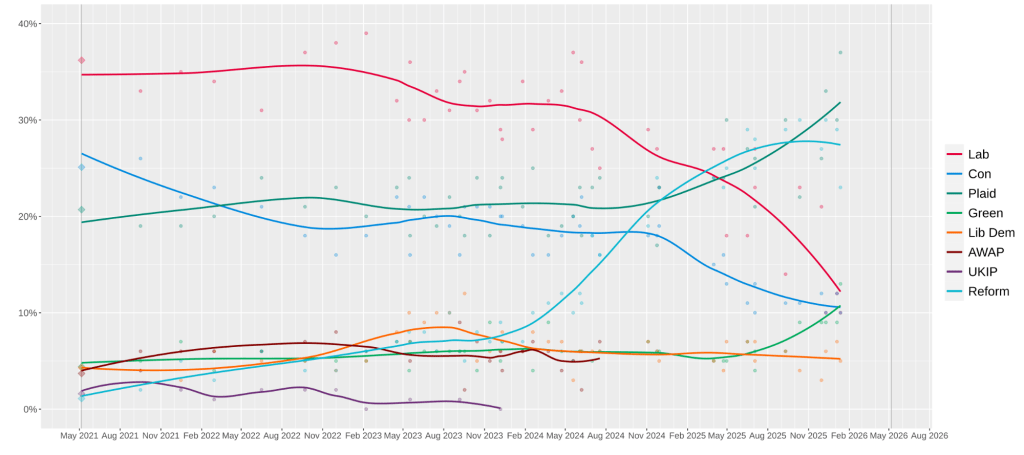
Labour have been in power in one form or another since devolution began, but 2026 could well be the end of that hegemony. Those on the populist right such as former Reform MP Rupert Lowe have called in the past for the expansion of the Senedd to be stopped, and for the entire establishment to be abolished. It is interesting to note that while in the past Reform UK have “not ruled out scrapping the Senedd”, since soaring in the polls and being projected to possibly win the election, they have suddenly become much quieter about this idea. Isn’t it strange how you are much less likely to want to destroy an institution, if there is a possibility you could soon be controlling it?
While politicians have never been popular, there is a real argument that more politicians would provide higher quality scrutiny and legislation, improving the lives of the people of Wales and demonstrating that we can be bold and distinctive. Future articles will explore the changes to the voting sytem which could benefit Reform UK, the changing constituencies which end the direct election of an individual and instead give power to the party to decide who represents an area, and how our politicians can be held to account in the new Senedd.


 Politics with Alex
Leave a comment