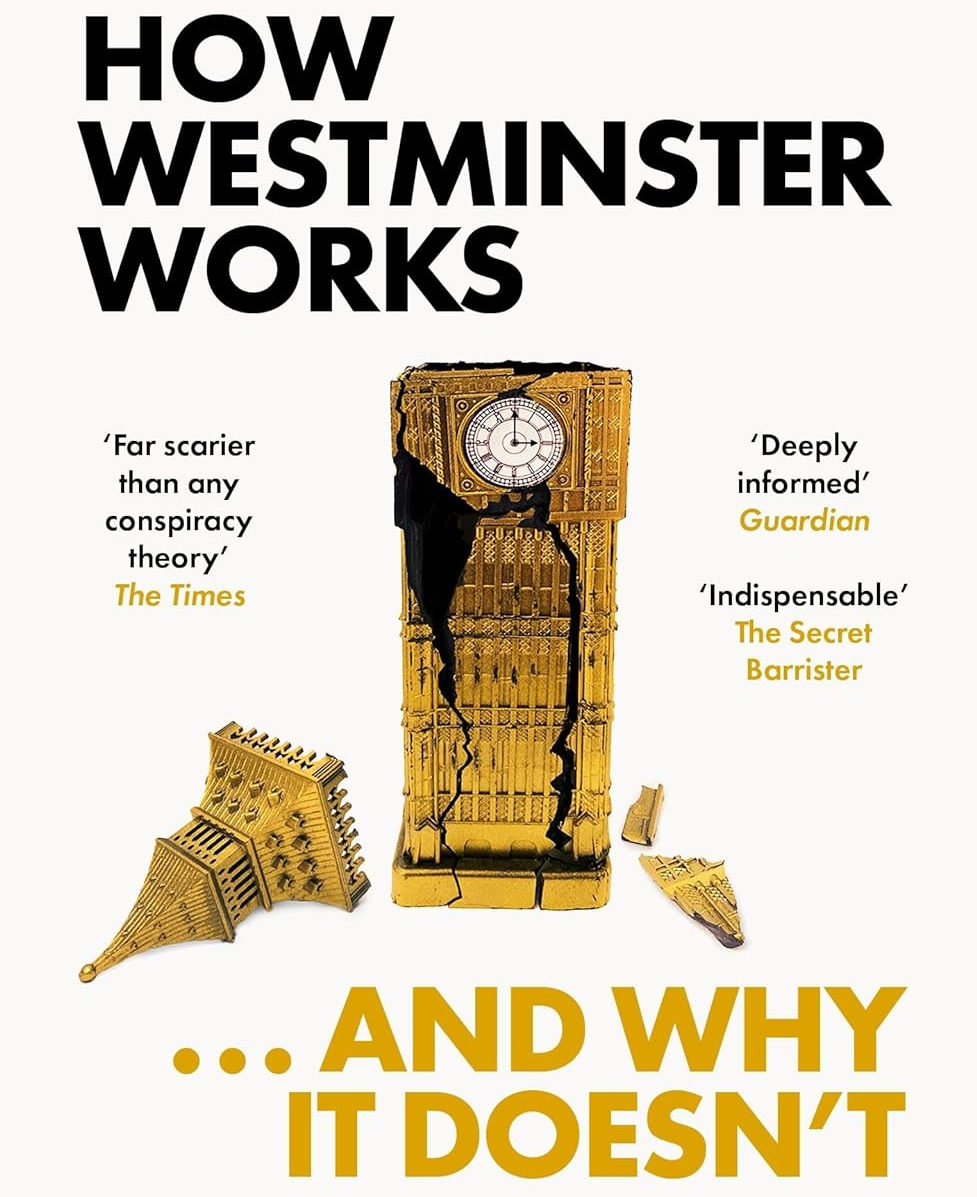
Westminster is often referred to as the ‘Mother of Parliaments’, something to be admired and venerated and a system that (along with centuries of colonial oppression) we exported in various ways around the world. It is easy to assume that behind the recently restored clocktower of Big Ben the cogs of Parliamentary democracy run as smooth as clockwork. Sadly, nothing could be further from the truth. Written by political journalist and broadcaster Ian Dunt, How Westminster Works…And Why It Doesn’t devastatingly exposes that behind the crumbling façade of the Palace of Westminster lies the crumbling façade of the British state.
Published in 2023, Dunt systematically goes through each section of the state and explains how it should work in theory, before looking under the bonnet and revealing how it works in reality. The chapters follow the narrative of the political cycle, starting with the selection of MPs and elections, before moving on to how the Prime Minister’s office and Downing Street is set up, the role of ministers and the civil service, the media, how laws are passed, and how the House of Lords works. In doing so, it deftly illustrates quite how dysfunctional the system can be. From the system of patronage that means ministers are rarely in office long enough to become experts in their brief, to the system of whipping that means Members of Parliament rarely know what they’re even voting on, to the lack of funding for the media to be able to effectively scrutinise or draw attention to what is happening, and even the absurd fact that the epicentre of power is not in a purpose built office with suitable conference rooms and facilities, but in a (relatively) small 17th century townhouse.
By going through the process from elections to legislating and scrutinising, Dunt helps you consider how at every stage things are designed to maximise the power of the executive and to minimise scrutiny and debate. It highlights that the Government is very good at announcing things, but very bad at delivering. The book demonstrates this to devastating effect using two case studies at the start and middle of the book; the failed experiment in privatising probation undertaken by Chris Grayling in 2013, and the ineffective and chaotic attempt to evacuate people from Afghanistan overseen by Dominic Raab in 2021. Throughout the book, Dunt speaks to a dizzying array of contributors including current and former politicians, experts on constitutional reform and government, senior civil servants among others. It is clear that Dunt knows the subject well and has put in the leg work needed to consider the possible root cause of the issues explored in each chapter.
The book also puts up a surprisingly robust defence of the House of Lords; often derided as an undemocratic and out of touch chamber that should be abolished. Here, Dunt patiently explains that the inbuild Executive dominance over the Legislature in the Commons means that legislation gets next to no scrutiny as they attempt to push laws through in a parliamentary session by controlling who scrutinises and how long they can do it for. Conversely, the House of Lords are free from many of the same political pressures or timetable limitations; those crossbench peers have the time and often experience to provide a more effective check on executive power than the Commons ever can.
Yet, where the book feels weakest is in providing realistic solutions to the issues outlined. Running to less than 30 pages (out of 355), Dunt briefly and cursorily suggests major changes to politics in the UK including proportional representation, changes to how legislation is passed, and the support available to opposition and backbench MPs to properly scrutinise. In places this feels like a good starting point, but in others it feels simplistic or naïve. When the executive could still hold such sway over the legislature, would such reforms allow parliament to truly assert itself, or is this more tinkering around the edges?
It is often said that any major reforms to how Parliament or Government function are usually done in the first 2-3 years of a new Government term; they have the mandate, and they can expend the political capital. Blair did so with Lords reforms, Cameron with the fixed term parliament act (now gone). With a likely changing in government this is the opportunity for the new Government to be bold and to address some of the gaping holes in the system exposed here.
How Westminster Works … And Why It Doesn’t is written by Ian Dunt, and is published by Weidenfeld and Nicholson



 Politics with Alex
Leave a reply to Book Review: ‘Code of Conduct’ by Chris Bryant – Politics with Alex Cancel reply